Michael Ruhlman at Degustibus/Macy’s (11/29/07)

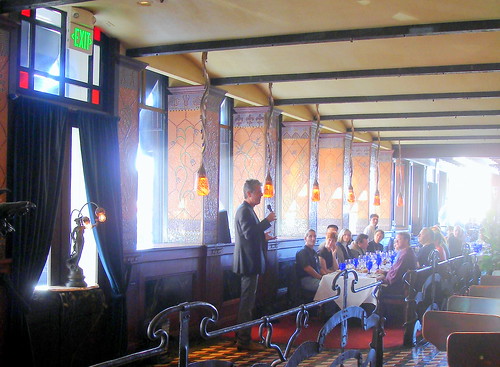
The inherent advantage of such an intimate space as Degustibus’ cooking school is that it immediately transformed Michael Ruhlman’s cooking demonstration from a sprawling classroom exercise into a warm, little cocktail party – albeit one in which the food, not the guests, circulated – or, more aptly, into a small dinner party in a large home kitchen, with Michael as one’s ever-genial and profoundly laid-back host.

Michael noted that, as a latch-key child growing up in 1970s Cleveland, “there was nothing fresh in the house!” and that his first culinary excursion involved a pear gallette made with a can of pears in syrup (“a total disaster”), but that the curiosity about and hunger for good food remained with him: through his journalism career, through his writing career (“I wrote a novel. I got an agent. I wrote another novel – I got nothing!”), and through the magazine article he was assigned to write on cooks – “It was then I realized chefs knew something I didn’t.”

That article led to Michael thinking about writing a book about chefs, which, in turn, prompted him to do research at the CIA {“who, naturally, thought I was just trying to scam a free culinary education – which, of course, I was”), eventually evolving into his seminal work, The Making of Chef -the rest, being, as they say, food lit history.

While being spoiled not only with the pack of recipes for the dishes Michael was preparing for the evening, fistfuls of Macy’s discount cards and the sage advice from Arlene Sailhac, head of the Degustibus program (“Don’t try to go down and use them tonight! The main floor is packed with tourists!”), not only did flutes of Champagne start arriving (Taittinger, Brut La Française, a delicate, pale gold bubbly with a nice toasty finish), but so did the added surprise of a little salumi on crostini, courtesy of Chris Cosentino at Incanto – and, yes, he ships:

http://www.boccalone.biz/

(The particular salami in question, by the way, was very subtle and nutty – redolent of acorn-fed pigs very happily snuffling their way through the great oak forests of – . . . of . . . l’entroterra fiorentina? suburban Oakland? Truly lovely. Looked like Cosentino’s salame pepato, but tasted like a fine jamon iberico. Props, Chris. But enough ProPIGanda for now.)

Fortified by the crostini, Michael happily threw himself into the preparations for his first dish, lardon salad with spinach and arugula, beginning with cooking chunks of his Traveling Pork Belly cooked with a little water in the pan to render it. (Question: “Is that the pork belly that rode with you from the CIA this morning?” “No, it’s the pork belly that’s been hanging out in my hotel room this morning!” Touché, Michael.)

lardonsalad

[I must apologize here for the food pics being out of focus. Of course I have a macro function on my camera. Of course I know how to use it. Of course, overwhelmed by lardons and Champagne and discount coupons, I forgot to use it. All night. My apologies, Michael. Your dishes deserved much better.]

Lardons and salumi notwithstanding, at all times, Michael stressed what impact becoming a cook – and being a cook – had on him, not just in terms of thinking about and managing time, but preparation and economy of motion – “I could not be a cook unless I changed who I was” – but, more importantly, about care and watching the details: “What makes a great cook is paying attention,” before – oops! – slightly burning his shallots. (“This has happened at every demo!”) Great cooks have bad days, Michael – great cooks have bad days . . .

(Michael never moves – but his hands never stop:)
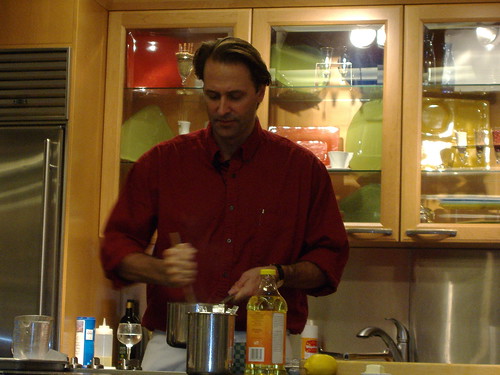
michaelstirring

Great cooks also have Arlene Sailhac, one hopes, who, will not merrily topping off the Champagne flutes or generously pouring the Chablis for the scallop-asparagus dish (Chablis Louis Jadot-Burgundy, very elegant), smoothly fulfilled her duties as MC by peppering Michael with a slew of questions and encouraging same from the unnaturally (for New York) quiet back of the house. (The same could not be said of the front of the house. Oh, no. The front was another matter entirely. But I digress.) Warm, effusive and bustling, Arlene nonetheless took Michael a bit aback with her intensity, until it was correctly pointed out that Mme. Sailhac was not, in fact, a juggernaut, but a typical Jewish mother, in the best possible sense:

Michael: “You’re right – that’s my New York mother!”
Arlene: “And least he didn’t say grandmother! How old are you, anyway?”
Michael: “25!”
Arlene: “You’re adopted!”

– which she promptly did, before asking us all about the lardon salad. (“How is it? Is it good?”) Are you kidding, Arlene? Is it good? It’s bacon! (5 pounds of pork belly, spices (see Charcuterie), and seven days in a Ziplock baggy. Favoloso. So, a little nosh, a little noodging – it was all good. The only thing better? The bacon with a maple ice cream, of course.

Michael and his New York Jewish “mom”:
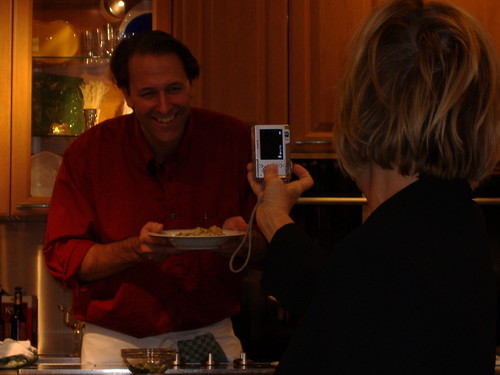
michaelsmom

and the dish he was most proud of: seared sea scallops in asparagus sauce:
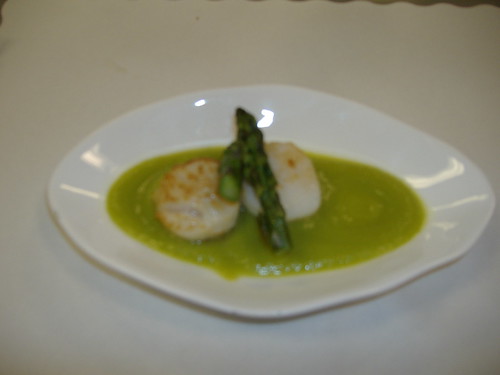
scallops

Moving smoothly, Michael then tackled seared scallops with asparagus in its own asparagus sauce, made brighter with a squeezing of lemon (“Reminds me of something Eric Ripert always says: ‘Lemon saves the ass of so many dishes’”), while simultaneously breaking down a chicken for blanquette de poulet and the stock used for it. The mirrored façade above the demo kitchen really came into its own at this point, enabling the audience to see, in visible realization, not just a cook’s time line but also his or her time management of several dishes – from the “stunt” stock barely simmering on the far right, the chicken coming to a boil next to it, the beginnings of the roux next to that (all on one fine German-engineered range), a cutting board with gremolata working, followed by a second fine, German-engineered stovetop with the remains of the seared scallop and sassily bright asparagus sauce. (By the way, when the red lights on a fine, German-engineered range are on, it means the burners are off. Go figure.)

The mirrored façade:
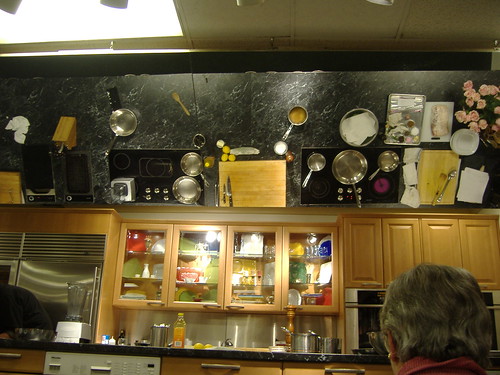
mirrorfacade

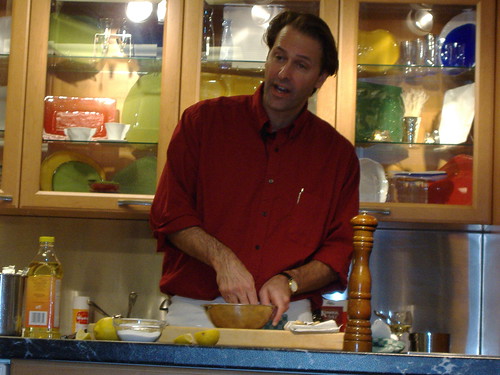
By now, happily sated with Champagne, Chablis and a robust red (St. Francis Red, Sonoma Valley) of vague provenance but reminiscent of a well-mannered Shiraz (who cared, at this point? Who knew?), Michael serenely answered questions while demonstrating his one-handed pasta-kneading technique, prompting a brief rumination on mixing pasta dough by hand (the way God intended, as any Italian will tell you) as opposed to by food processor (sacrilege, since you asked). (Why is it sacrilege? Because Italians cook and make food fatto mano – by hand, capisce? – because we can feel the texture of pasta or a meatball, as much as you see or smell or “hear” the doneness of your food. Why? Because even though we buy dried pasta most of the time, we are still a tactile, sensuous people with tiny, fierce, big wooden spoon-wielding nonne in our pasts, and we were raised right. So, when we make it fresh, no machina automatica for mixing, just for rolling out. Is why. Ma va!)
michaelkneading

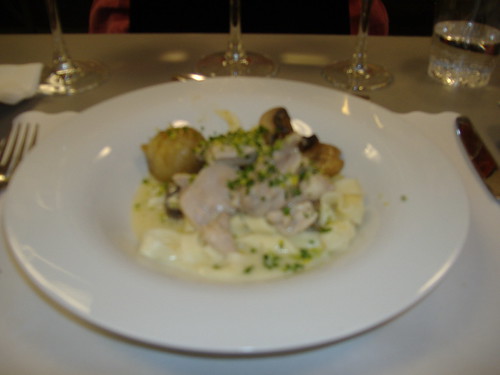
One-handed or otherwise (Michael: “Leaves one hand free to answer the phone.” Audience: “No, it leaves one hand free to drink the wine!”), kneading the pasta left Michael free to think aloud about the essence of food itself, as both sustenance and nurture. Asked if his wife, Donna, cooks, Michael replied, “No, and as I can be something of an asshole in the kitchen [she won’t”], or if his children are turning into cooks themselves (“No, they eat hot dogs and white rice. It’s very frustrating!”), but spoke longingly of loving those moments, mid-afternoon, with his wife in the kitchen, just talking, discussing their kids, and asking if there was anything he could cook for her. Of the importance, to him, of “rootedness” of being rooted, of going back home to Cleveland after college and staying there (“We are losing our culture by raising our kids in a series of disconnected homes”) with the acuity only a single, latch-key child could have. Of care, of paying attention – equally as important in the home cook as the professional chef.
blanquette

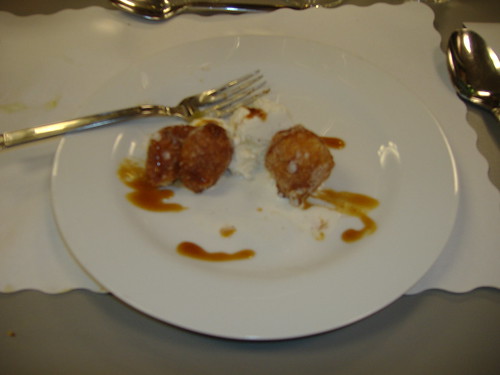
And what says caring but – dessert? Cinnamon-Sugar Choux Doughnuts with Ice Cream and Rum-Caramel Sauce. Oh, yesssss. Flushed with success from his blanquette and its ethereal noodles (fatto mano by Ameril, the Degustibus sous chef), Michael not only started the pate choux, but cavalierly decided to make the caramel sauce à la minute, despite warnings from his sous, Wes (“He’s been telling me all day it’s going to take too long”), and a standby bottle of chocolate sauce. It didn’t. With 10 minutes still on the clock, Wes on the Fryolator and a rather indiscreet infusion of rum, the choux went flying out of the kitchen and down the gullets of the appreciative horde so rapidly that mine was the only one left even vaguely intact for photographic purposes:
donuts

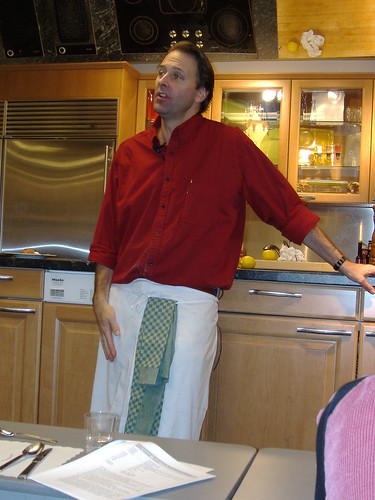
So, no, there were no unscheduled appearances of cauliflower or irate Cosentinos at this particular demo. No alarming drop-bys of a darkly snarking Bourdain lurking behind the coat racks. Just a man and his craft, demonstrating the care that goes into that craft – and perhaps making us all think a little of pate choux doughnuts with rum-caramel sauce, and MAPLE ice cream. With bacon, please.
michael2


Truffle Overload

A massive post-Thanksgiving cold has killed my energy, appetite and taste buds, but this caught my eye:

a three-pound truffle

Truffle hunter Cristiano Savini said Tuesday he was searching for truffles with his father last week in Palaia, about 25 miles from Pisa, when his dog, Rocco, started sniffing “like crazy.”

With Rocco leashed to a tree to prevent him from digging too furiously, the Savinis carefully extracted a truffle they said weighed about 3.3 pounds.

The monster truffle will be auctioned off to benefit three charities. Very nice.


New York Chocolate Chip Cheesecake

This is an extremely easy to make, New York style cheesecake recipe that does not require a water bath during baking, just a little patience while the cake cools.

Ingredients:

The Crust:
30 chocolate chip cookies, crushed into small crumbs
2 tablespoons butter, melted

The Cake:
4 (8 ounce) packages cream cheese
1 1/2 cups white sugar
3/4 cup milk
4 eggs
1 cup sour cream
1 tablespoon vanilla extract
1/4 cup all-purpose flour
1/2 cup semi-sweet chocolate chips
1/2 cup white chocolate chips

Preparation:

1. Grease a 10-inch springform pan. In a medium bowl, mix cookie crumbs with the melted butter. Press the mixture into the bottom of your pan. Refrigerate the crust for at least 30 minutes to let it set.

2. Preheat the oven to 350F.

3. In a large bowl, mix cream cheese with sugar until smooth. Blend in milk, and then mix in the eggs one at a time, mixing just enough to incorporate. Mix in sour cream, vanilla and flour until smooth. Fold in chocolate chips, and pour the mixture onto your crust.

4. Bake in preheated oven for 1 hour. Then turn the oven off, and let the cake cool in the oven with the door closed until it comes to room temperature; this is a very important step that prevents the cake from cracking. Depending on your kitchen and the size of your oven, this will take about an hour. Resist the temptation to sneak a quick look. After that, you can remove it from the oven. Chill in refrigerator for at least 4 hours – overnight is better.

Notes

  • We usually use either Pepperidge Farm or Famous Amos chocolate chip cookies for the crust, but any decent-quality cookie can be used as long as it is crispy. The soft & chewy versions should be avoided at all costs.

Pumpkin Chocolate Creme Brulee

PUMPKIN CHOCOLATE CRÈME BRULEÉ OY VEY!

This is the basic mini-“brool” (4.5 oz.) version, makes 6. For 12-14 brools, double up.

Day One:

For the chocolate bruleé:

3 egg yolks
¼ cup milk
1 cup heavy cream
4 tablespoons sugar, divided
8 ounces semi-sweet chocolate baking chocolate

Day Two:

For the pumpkin bruleé:

3 heaping tablespoons of canned pumpkin pureé
3 egg yolks
1 cup heavy cream
3 tablespoons sugar
1 vanilla bean, scraped

Day 1 (because the chocolate needs to sit overnight):

1. Melt the chocolate in a double boiler.

2. In a small sauce pan, bring milk, cream and half the sugar to a boil.

3. Place yolks and the remaining sugar in a heatproof bowl, and slowly pour in the hot milk mixture, whisking continuously. Too fast, and the eggs will curdle (or scramble. Yeccchh).

4. Add the chocolate to the custard, transfer to a clean, cool bowl, cool, and refrigerate overnight. (A hot bowl (especially metal) will keep cooking the custard.)

Day 2:

5. Preheat oven to 300º.

6. Separate egg yolks from egg whites and add yolks to pumpkin pureé in big fat bowl. Whisk together.

7. Slice open the vanilla bean lengthwise, scrape it on a paper towel, and add to milk/cream/sugar mixture below.

8. In a small sauce pan, bring milk, cream and half the sugar to a boil.

9. Place 6 4” ramekins on cookie sheet and fill in, first with the chocolate bruleé, then the pumpkin – 7/8 full is full enough.

10. Fill the bottom of the cookie sheet/jelly roll pan with water, so the bruleés cook evenly. Cook for about 35 minutes, or until bruleés shake like Jell-o. Might need to got to 50 minutes. Cool, then refrigerate until firm.

Just before serving, sprinkle bruleés with sugar and broil for a few seconds, until tops are caramelized. Or, better yet, use the brand-new bruleé torch sent by dear Uncle BeeEEerrrnie. Serve immediately (like you had a choice, because the wolverines will already have been tearing at you the second dinner was finished).


Pumpkin-Chocolate Cheesecake With A Gingersnap Crust

MARBLED PUMPKIN & CHOCOLATE COGNAC CHEESECAKE WITH A GINGERSNAP CRUST AND CARAMEL-PECAN TOPPING

Crust:

30 2-inch gingersnaps, finely ground
3/4 stick (4 oz.) unsalted butter, melted and cooled
½ cup pecans (optional)

(for cinnamon crust, use 1 cup graham crackers, 2tsp. cinnamon and 2 tbsps. sugar)

Filling:

6 oz. bittersweet chocolate, chopped or broken up
11/2 lbs. (12 oz.) of cream cheese, softened
1 cup sugar
4 large eggs, at room temperature
11/2 tablespoons cornstarch
1 teaspoon pure vanilla extract
1 lb. canned pumpkin purée
½ teaspoon cinnamon
½ teaspoon nutmeg
pinch of ground cloves
2 tablespoons Cognac, Armagnac or bourbon (preferably Wild Turkey)

Topping:

1 cup (packed) dark brown sugar
½ cup whipped cream
6 tablespoons (3/4 stick) unsalted butter
¼ cup light corn syrup
½ teaspoon salt
3-4 tablespoons (of whatever booze you used in the filling – optional)
1 ½ cups pecan halves, toasted (350 degrees for 4 minutes)

Make crust:

1. Pre-heat oven to 325°.
2. Toast pecans for 2-3 minutes, until fragrant ands lightly brown.
3. Mix gingersnap crumbs, pecans and butter together (both crushing and mixing can be done in a food processor), and then press onto bottom (and a little up the sides, if you have enough crumb) of a buttered spring form pan.
4. Bake crust in middle of the oven until edge is golden brown – about 8 minutes. (Watch carefully towards the end – gingersnaps burn easily). Cool in the pan on a rack.

Make filling:

5. Melt the chocolate in a double boiler, stirring frequently.
6. In a large bowl or stand mixer, beat the cream cheese until smooth. Add the sugar and beat until light and fluffy. Add the eggs, one at a time, beating well between additions. Beat in the cornstarch and vanilla.
7. In a separate large bowl, mix together the pumpkin purée, cinnamon, nutmeg, cloves, and Cognac. Add this to the cheesecake batter and mix until really fluffy – almost mousse-like.
8. Lightly mix about half of the melted chocolate into the batter, basically by swirling the chocolate as it pours. Pour into buttered spring form pan. Repeat with other half of the chocolate, making swirls or marbling patterns as you pour. Don’t over-stir – this is the free-form, no-rules part (!)
9. Set the spring form pan onto either a roasting pan or jelly roll pan, put into the center of the oven, and either fill the jelly roll pan as full as you can with hot water, or the roasting pan about half-full. Bake the cheesecake, in its hot bath, for about 1½ hours, or until the cake is firm around the edges but slightly jiggly in the center. Turn the oven off, prop open the door, and let the cheesecake set in the water bath in the oven for 1 hour, or until completely set.
10. Remove cheesecake from the water bath and chill thoroughly (at least 4 hours) or overnight. The cheesecake can live happily in the fridge in its springform for up to four days. When ready, remove the springform rim and plate as desired.

Make topping:

11. Bring sugar, cream, butter, corn syrup and salt to a boil in a medium sauce pan, whisking until sugar dissolves; boil 1 minute without stirring. Remove from heat, stir in booze, then pecans. Cool, stirring occasionally. Top cheesecake, using a spatula – this is easier when sauce is fully cooled.


(Sort of) Meeting Tony Bourdain

Hard on the heels of his occasional partner-in-crime Michael Ruhlman, bad-boy chef, author, and TV personality Anthony Bourdain was here in San Francisco this weekend promoting his own new book, “No Reservations: Around the World on an Empty Stomach“. He was scheduled for several events, and we signed up to see him at Book Passage’s “Cooks With Books” lunch at Boulevard restaurant.

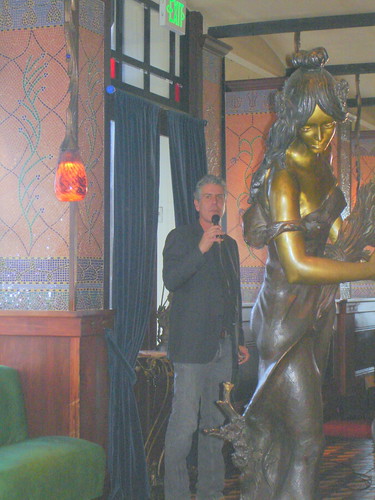
Tony Bourdain speaking

I’d like to say we had as good a time at this event as we did at the one last week, but we didn’t (well, at least I didn’t. Scott may feel otherwise). Bourdain is a star of much bigger magnitude, and there’s just no way you can get the same level of spontaneity or intimacy at a four-course sit-down meal with well over 100 guests than at a regular signing. It’s not just the sheer increased number of people, though. It’s also directly connected to the nature of fame, and the impossibility of remaining fully open and accessible when the number of people wanting to interact with you has geometrically increased.

Bourdain signed a huge pile of books, spoke briefly, answered audience questions, and was exactly as you’d expect him – funny, pulling no punches, and occasionally potty-mouthed. The event was polished, professional, well-managed, and the food, although not top-notch, was decent. But all in all, it wasn’t really fun. Instead, I felt bad for Bourdain that he has to go through this grinder, and I wasn’t too thrilled with myself for being a part of it. It was nice to see Bourdain face to face, and I’ll be the first to admit that having an autographed copy of two of his books is more fun than not, but honestly, I am not sure I would go to that kind of event again.

Bourdain is a very smart guy, and I’m sure he knew what he was in for when he chose to take the path of author / TV personality over that of a chef. Signing autographs for a couple of hours is work, but standing in front of a hot stove for 12 hours is a hell of a lot harder. On the other hand, at least when you’re done with your 12-hour shift, you can go home and not have to worry about people snapping your picture as you duck into KFC for some take-out.

Musing over the nature and price of fame is hardly new ground, and it’s starting to move away from the focus of this blog anyway. To get back on track, here’s another shot from today:

Tony Bourdain speaking

UPDATE: Scott’s report on the event is a lot funnier than mine.


Le Beaujolais Nouveau est arrivé!

Yes, I know. It’s more of a marketing promotion than a decent wine, especially in recent years.

Well, so what. Beaujolais Nouveau tells me that Thanksgiving is almost here, and brings back memories of cooking-filled Thanksgiving days at my aunt’s house, where the family would congregate with a monster pile of food and many bottles of wine, and spend the day together. I’ll be leaving for New York to do just that in a few more days.

So bring on the Beaujolais Nouveau! It may be plonk, but it’s plonk that makes me happy. And it really does pair nicely with turkey. Try it and see for yourself.


Building Blocks: Roasted Tomato Sauce

There’s a category of recipes that I call “Basics”. They’re not in themselves complete recipes; instead, they are building blocks that help you assemble other recipes. The most obvious is stock (about which more later) but one less obvious one is tomato sauce.

As any even semi-serious cook knows, the quality of your ingredients is key to the quality of your finished dish (or put another way, ‘Garbage in, Garbage out’). Getting your hands on really good fruits and vegetables can be a real issue, especially in the colder months.

There’s always options, of course. When it comes to tomatoes, high-quality canned ones (especially Italian ones) can work really nicely. However, we’ve found that if you really want an intense, fresh tomato flavor in your dish, you can’t beat roasting. It makes good tomatoes better and makes passable tomatoes usable.

So here’s what we do:

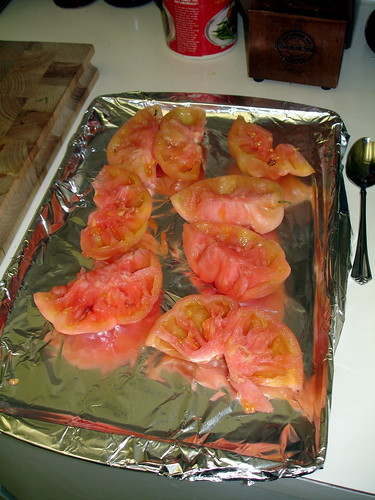
Take a couple pounds of fresh, ripe tomatoes. Heirlooms if you can get them, but any tomato will work. Cut them into quarters and de-seed:

Tomatoes Before Roasting

Drizzle with a little olive oil. Roast in the oven at 350 degrees F for 60 minutes. Remove the trays from the oven and allow the tomatoes to cool, then toss into a blender and puree.

The result is an intensely flavored sauce that’s a good base for a lot of different preparations. I divide each batch of sauce into 2-cup portions and freeze them in separate freezer-safe baggies, then thaw and use as needed.

NOTE: Roasting canned tomatoes doesn’t cut it (we’ve tried).


Meeting Michael Ruhlman

One of the nice things about living in a major urban area is that authors generally include San Francisco on the itinerary when they’re doing book tours. Michael Ruhlman has a new book out, The Elements of Cooking: Translating the Chef’s Craft for Every Kitchen, and luckily for us, SF was an early stop on his itinerary.

Book Passage in the Ferry Building is a small shop, and they had their hands full making space for the full-house turnout. We got there a few minutes before the event was schedule to start, and practically walked right into Ruhlman as he stood there chatting with a few folks by the door. He was gracious to all and was kind enough to pose for a photo with Scott and I.

United in a love of cooking

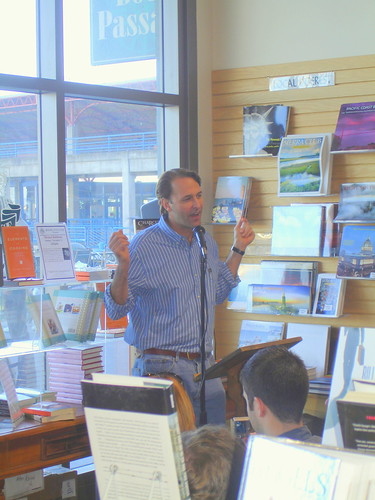
Eventually the event got underway, including Ruhlman doing a short reading from the essay on finesse (pp.47-49, if you’ve got a copy already) and taking some questions, then the signing.

Michael Ruhlman

I didn’t take notes during the Q&A session, so I can’t give an in-depth report on the questions asked, but they ranged from questions about judging Michael Symon and where he’d be eating dinner tonight (sadly, the answer to that was “In an airport”) to my own somewhat ineptly-phrased question about the discipline of writing. I mentioned Tennessee Williams in the question, so Ruhlman went off on the dangers inherent in writing and the high number of alcoholics & drug addicts who wrote, which although interesting wasn’t what I was asking about. The error was mine in not being more clear, though.

At any rate, it was all a pretty standard book signing event until something unexpected happened. As we were slowly moving through the signing line, all of a sudden, we hear someone yelling “I’m coming for you, Ruhlman!” and who should we see but Chris Cosentino, would-be Iron Chef and SF resident, waving a cauliflower and smiling broadly. (If you didn’t watch “The Next Iron Chef” the cauliflower won’t make much sense, but if you did, you’ll know exactly why he brought it.)

Ruhlman looked just as surprised as everyone else, and greeted Cosentino warmly. I tried to get a photo of them saying hello, but some schmo with a smartphone was standing in my line of sight. They were nice enough to pose with the cauliflower afterwards, though.

Ruhlman, Cosentino, and a cauliflower

We got to chat with Cosentino after we’d gotten our book (and Scott’s personal recipe book) autographed. Nice guy. if he was unhappy with how things turned out for him on “The Next Iron Chef” he’s gotten over it, or at least can put a good game face. I assume that he and Ruhlman went off to spend a little time chatting before Ruhlman had to get back on an airplane.

So that was our food adventure for the day. We’ve got roasted tomatoes cooling off right now, and dinner prep will start soon. I’m looking forward to reading Ruhlman’s book this week.

UPDATE 11/17: Another report on the day can be found over at Justinsomnia. And at Scott’s place, of course.


Easy Summer Fruit Torte

One of Mom’s recipes and an awesome dessert. It’s easy to make, tastes great, and is not so rich that you’ll feel insanely guilty eating it.

Ingredients:

Cake Base:
1 cup sugar
1 cup flour
1/2 teaspoon salt
1 teaspoon baking powder
1/2 cup butter (room temperature)
2 eggs

Topping:
12 small ripe purple plums, halved and pitted
OR 12 small ripe apricots, halved and pitted
OR 1 to 1/12 cups fresh berries (raspberries, blueberries, blackberries are best)
1 tablespoon sugar
1 tablespoon cinnamon
2 teaspoons lemon juice (optional)

Preparation:

Preheat oven to 350 degrees. Lightly grease a 9″ springform pan.

Cream the butter and sugar together (if you don’t know how, here’s a helpful link).

Combine the flour, baking powder, and salt and sift into a bowl, then add them, as well as the eggs, to the butter and sugar. Mix well but do not overwork the dough. Pour into the pan and smooth out the batter with a spatula to make sure it’s evenly distributed.

Add the fruit. If you’re using apricots, plums or strawberries, place the fruit halves skin side up so that the juices run down into the cake as it cooks. Raspberries, blackberries, and blueberries don’t have sides so just sprinkle them on. Tap gently on the fruit pieces to settle them into the batter, but not so firmly that they’re completely covered.

Sprinkle the top of the cake with sugar, and cinnamon and if necessary the lemon juice, adjusting the amount of each depending on the type and tartness of the fruit.

Bake for 1 hour.

Notes & Substitutions:

  • This cake is best served warm.
  • Can be baked in advance, frozen, and reheated.
  • If you don’t have a springform pan, a 9″ cake or pie round will also work. Grease the pan heavily and/or line with parchment paper for easier removal.